Why I Built HOA Engine: A Florida Board President's Software Origin Story

Updated: May 6
In 2017, I bought a beachside condo on Florida's Space Coast thinking I was getting a low-maintenance slice of paradise. Within a few years I was the board president, staring down a failing roof, a bank account with $10,000 in it, and a community that had stopped trusting its own leadership. I am an electrical engineer by profession and a problem-solver by instinct. When I took over the presidency I treated every challenge the same way I treat an engineering problem: understand the requirements, build the right system, and maintain it consistently.
What I found when I started looking for software to help manage our community changed my career trajectory in a direction I never anticipated.
The Problem With Every Platform I Tested
The HOA management software market in 2023 and 2024 looked impressive from the outside. Dozens of platforms with polished websites, feature lists a page long, and pricing structures that ranged from affordable to genuinely surprising. I tested most of the major ones. I signed up for trials, imported our community data, ran the workflows we actually used, and tried to understand whether any of them would genuinely solve the problems I was dealing with as a Florida board president.
They were all built for the wrong person.
PayHOA was the most popular self-managed platform and genuinely the best of the mainstream options. Clean interface, good dues collection, solid bank integration. But no Florida-specific compliance tracking. No awareness of the difference between Chapter 718 and Chapter 720. No board certification deadline monitoring. No estoppel certificate generation. No AI that could read my bylaws and answer a question about them. The platform was built for any HOA anywhere in the United States, which meant it was optimized for none of them in particular and certainly not for a Florida condo with post-Surfside SIRS requirements, a 10-business-day estoppel deadline, and annual board member certification obligations under Florida Statute 720.3033.
The enterprise platforms like Vantaca and CINC Systems were built for professional management companies handling dozens of communities simultaneously. They were solving a different problem entirely: how to scale a portfolio. I was not managing a portfolio. I was managing ten units on the Space Coast. The feature sets were impressive and irrelevant. The pricing was built for a company charging management fees, not for a volunteer board president trying to save his community money.
The accounting-focused platforms all had the same problem: they were not HOA accounting platforms. They were general small business accounting platforms that could be configured for HOA use with enough effort. The reserve fund separation that Florida law requires for condo associations was not enforced. The payment application order that Florida statute specifies for delinquent accounts was not built in. The estoppel certificate that title companies need within ten business days of a request was not generatable. Every one of these things required either a workaround, a manual process, or a separate tool on top of the platform.
What I kept finding was software built by people who had never actually sat in the president's chair of a small Florida community association and dealt with the problems that chair creates.
The Decision to Build It Myself
I am a software engineer as well as an electrical engineer. I have written code professionally for years. The decision to build my own platform was not a casual one. It was the decision of someone who had exhausted the alternatives and concluded that the thing he needed did not exist and that he had the skills to create it.
I started with a list of everything I actually needed as a Florida board president. Not a general list of HOA software features. A specific list of what I needed to run my community correctly, legally, and without paying a management company or a CPA for things a properly built system should handle automatically.
The list was long. Full double-entry accounting with proper fund separation between operating and reserve accounts. Plaid bank integration for live transaction feeds. Check scanning with OCR so the treasurer could process physical dues payments without manual entry. Vendor payouts via ACH. A budget builder that used actual spending history as its foundation instead of a blank spreadsheet.
Florida statutory compliance tracking that knew the difference between Chapter 718 and Chapter 720, that monitored board certification deadlines, that tracked SIRS and milestone inspection reporting windows, that generated the 30-day document posting reminders the website compliance law now requires, that produced the One-Click Compliance Bundle for annual distribution.
An estoppel certificate generator that produced the Florida statutory form in one click from the existing accounting data. The owner portal that gave residents self-service access to their dues history, their violation status, association documents, and ballot participation. The violation workflow with photo evidence, fining committee documentation, and escalation tracking that matched the legal process Florida requires.
Governance tools: elections and ballot management. An AI Bylaws Assistant that could read the governing documents and answer plain-language questions about them. Meeting scheduling with integrated video conferencing, attendance tracking, AI-assisted meeting notes, and automatic recording workflows for the 2025 virtual meeting requirements.
E-signatures for consent forms, resale documents, and anything else that needed a signature and an audit trail. A shared inbox with dynamic webmail routing. Broadcast communications. The IRS Form 1120-H generated directly from the ledger. 1099-NEC tracking and W-9 collection from vendors. A data migration wizard for boards moving from other systems.
And a progressive web app, installable on any phone, because board members and owners do not all sit at desks.
What It Took to Build It
Building HOA Engine took most of 2024 and into 2025. I built it nights and weekends alongside my professional engineering work and my ongoing role as board president. Every feature came from a real problem I had encountered running my community. The check scanning OCR came from watching our treasurer spend hours manually entering paper dues payments. The estoppel generator came from nearly missing a 10-business-day deadline because we were producing estoppels manually. The board certification tracker came from discovering that a fellow board member had missed their 90-day education requirement and was technically suspended without knowing it.
The Florida compliance tracker was built statute by statute, requirement by requirement, from my own reading of Chapters 718 and 720 and every amendment passed in 2022, 2024, and 2025. I was already reading this legislation for the book I was writing about Florida HOA and condo management. Building it into software was the natural extension of understanding it deeply enough to explain it to someone else.
The AI Bylaws Assistant came from a moment every board member will recognize: sitting at a meeting, someone asks a question about what the governing documents say about a specific situation, and nobody can find the answer quickly enough to settle the debate. I wanted a tool that could read the documents and answer the question in plain language in seconds. I built it.
The double-entry accounting engine was the most technically demanding piece. I needed real accounting, not a simplified ledger. I needed it to enforce fund separation at the transaction level so a treasurer could not accidentally apply reserve funds to operating expenses without an explicit authorization step. I needed it to handle the Florida-specific payment application order for delinquent accounts. I needed it to generate the financial statements Florida law requires associations to distribute to owners. I built all of it.
Testing It on My Own Community
There is a saying in engineering: the best test is a real load. I did not run HOA Engine on a test database and call it ready. I ran it on my actual community, with real assessments, real vendor payments, real violations, real meetings, and real owners who needed access to real documents.
That decision produced two things. First, it exposed every gap between what I thought I had built and what actually worked under real conditions. Every edge case that a contrived test environment never generates appeared in the first month of actual use. Owner with an unusual payment history. Vendor invoice that did not match the format the OCR expected. Meeting notice that needed to go out on a timeline the calendar had not accounted for. Board member certification that expired mid-year rather than on the anniversary of election. Every one of these cases made the software better.
Second, it gave me something no other HOA software platform can honestly claim: I am a paying user of my own product. Not a founder who reviews dashboards. A board president who logs in to process vendor payments, run the monthly bank reconciliation, generate the violation notice for the owner who has been blocking egress in the shared garage, and set up the video conference for the annual meeting. I use it the way you will use it, and I have a personal financial stake in whether it works correctly.
What HOA Engine Is Today
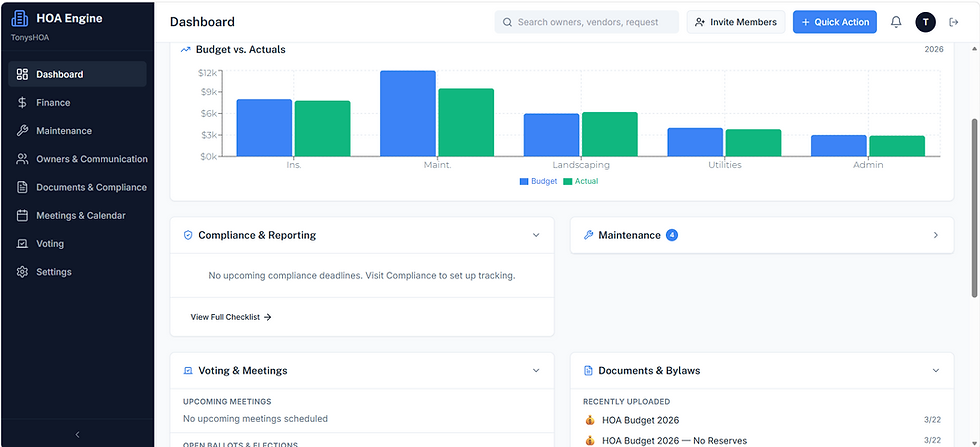
HOA Engine is live. It is running on my Florida condo association on the Space Coast as of 2026 and it is in active beta with early users who are shaping how it continues to develop.
The platform handles multi-association management with strict data isolation, role-based access for platform administrators, property managers, board members, and owners, and slug-based HOA URLs that give each community its own branded address. It supports both HOA and condo association types with Florida-specific handling for the differences between them.
The pricing is $19.99 per month on an annual plan or $24.99 month-to-month, flat regardless of how many units are in the community. I set that price deliberately. The most common alternative to HOA Engine is a property management company charging $500 to $7,000 per month for a community in Florida. I wanted the math to be undeniable.
What HOA Engine is not yet is a finished product. Software is never finished. But it is fully functional for the core workflows that Florida community associations run every month: dues collection, accounting, compliance tracking, owner communication, document management, meetings, violations, and the annual reporting cycle. The features that are still in development are on a roadmap shaped by real user feedback from real communities.
Why I Wrote the Book First
You may have found HOA Engine through the book Run the Board, or you may have found the book through HOA Engine. Either way, the book came first and that was intentional.
I wrote Run the Board because I wanted Florida board members and owners to understand the system they were operating in: what Florida law requires, what it protects, what the post-Surfside reforms actually mean, how to find contractors who are not ripping off the community, how to run a meeting that produces trust instead of screaming, how to build reserves correctly so a special assessment does not blindside everyone in year fifteen.
HOA Engine is the implementation of those lessons in software. The compliance calendar in the book became the compliance tracker in the platform. The financial controls framework became the multi-signature payment authorization workflow. The reserve funding math became the AI-assisted budget builder. The Florida statutory requirements that every chapter of the book covers became the 718 and 720 tracking engine.
The book gives you the knowledge. The software gives you the system. I believe in both because I needed both.
Who HOA Engine Is For
HOA Engine is built for Florida HOA and condo communities that are self-managing or considering it, that are paying a management company and wondering whether the value justifies the cost, or that are managing with spreadsheets and email and know there is a better way.
It is built specifically for small to mid-size associations where the board is volunteers who are not accounting professionals, not lawyers, and not property managers. People who took on the role because they care about their community and found themselves responsible for functions nobody trained them to perform.
It is built for the board president who is running the compliance calendar in their head and knows they will eventually miss something important. For the treasurer who is doing bank reconciliations in a spreadsheet and knows the margin for error is too high. For the vice president who is managing vendor relationships by text message and does not have a single place to find what was agreed and when.
It is built for Florida specifically because Florida is different. The Surfside-driven legislation. The SIRS and milestone inspection requirements. The estoppel certificate process. The board member certification deadlines. The 30-day website posting workflow. The payment application rules for delinquent accounts. The budget transparency requirements for condo associations. These are not generic HOA requirements that any software can address with a checkbox. They are Florida-specific requirements that required Florida-specific engineering.
I am the only person in the HOA software industry who has been a Florida board president while building and testing the platform on their own community. That is not a marketing claim. It is a verifiable fact that shapes every feature in the product and every post on this site.
If that sounds like what your community needs, visit hoaengineer.com to get started.
To learn even more, check out the following posts:


Comments