QuickBooks vs. HOA Accounting Software: What Florida Boards Actually Need

I spent about thirty minutes on the QuickBooks community forum before writing this post. The HOA section reads like a support group. Treasurers trying to figure out how to set up reserve accounts without affecting their bank balance. Boards asking whether to record dues as pledges or invoices. Someone wanting to know which equity account type to use for replacement reserves. Another person discovering that QuickBooks calls their dues billing "pledges" by default because it assumes you are a nonprofit, then finding out the workaround is to change the tax form setting to match a corporation, which changes the label.
These are not complicated accounting concepts. They are basic HOA accounting concepts that QuickBooks was never designed to handle, so every board that uses it has to reverse-engineer workarounds from first principles or dig through community forums hoping someone else already figured it out.
I am an engineer. I understand why this happens. QuickBooks is a general-purpose accounting platform built to serve millions of different business types. It does not know that your assessment income is not taxable under Form 1120-H. It does not know that your reserve account must be separated from your operating account under Florida law. It does not know that the payment it received from Unit 12 needs to be applied to late fees first, then assessments, in a specific order that Florida statute requires. It does not know any of that, because it was not built for you.
This post explains specifically what QuickBooks gets right, specifically where it fails for Florida associations, and what to look for in purpose-built HOA accounting software.

What QuickBooks Actually Does Well
QuickBooks is genuinely excellent at the general accounting functions that all organizations share. Double-entry bookkeeping, chart of accounts management, bank account integration, expense tracking, and financial reporting at the income statement and balance sheet level are all solid. If your association has simple, consistent finances and a treasurer with accounting experience, QuickBooks can be made to work with significant setup and discipline.
Bank account integration is a real strength. QuickBooks connects to most major banks and imports transactions automatically, which reduces manual entry and the errors that come with it. The reconciliation workflow, while not HOA-specific, is functional and reasonably intuitive.
The reporting suite is extensive. For a board that needs to present financial information to owners, QuickBooks can produce balance sheets, profit and loss statements, and budget-versus-actual reports that meet the basic requirements for Florida's financial reporting rules for smaller associations.
If you already have QuickBooks set up and working for your community, and the workarounds are not causing significant problems, this post is not an argument to throw it out. It is an argument to understand exactly what you are missing so you can decide whether those gaps matter for your specific situation.
Where QuickBooks Fails Florida Associations Specifically
The unit-based accounting problem is the most fundamental gap. QuickBooks is built around customers, meaning businesses and individuals that pay for products or services. It was not designed to track unit-based accounting where the ledger belongs to a physical unit, not a person. When an owner sells their unit and a new buyer takes over, QuickBooks requires creating a new customer record. Over time you end up with multiple customers for the same address with transaction histories that do not follow the unit. When a title company requests an estoppel certificate and you need to produce a complete payment history for Unit 7, pulling that from QuickBooks for a unit that has had three owners in five years is a research project, not a report.
The keeping of ledgers and the ability to break out line items such as special assessments, loan payments, late fees, interest charges, fines and penalties are quite specific to association bookkeeping and accounting. There are creative workarounds that can be employed but the level of training required is substantial and can be lost if the bookkeeping duties changes hands. This is a particularly substantial problem for condominium associations and HOAs that are relying on volunteers.
The payment application order problem is real and legally significant in Florida. Florida law specifies the order in which payments from delinquent owners must be applied: first to interest, then to late fees, then to legal fees and costs, then to delinquent assessments, then to current assessments. QuickBooks has no awareness of this rule and applies payments in whatever order you configure, which means a board using QuickBooks needs an accountant or attorney who knows this rule to verify that every delinquent account is being processed correctly. Purpose-built HOA software handles this automatically.
Reserve account separation is where QuickBooks creates the most compliance risk for Florida condo associations. Florida law requires that operating funds and reserve funds be maintained in separate accounts. For condo associations subject to SIRS requirements, using reserve funds for operating expenses without a formal board vote is a statutory violation. QuickBooks does not enforce this separation. You can create separate accounts in the chart of accounts and maintain the discipline yourself, but QuickBooks will let you transfer money between those accounts without any flag, warning, or governance control. QuickBooks is a generic accounting software, meaning it may not have the flexibility to accommodate the unique needs of an HOA. For example, you may need to track special assessments or separate reserve funds, which may not be easily done in QuickBooks without some manual adjustments.
The reserve funding gap goes deeper than just separation. Florida's SIRS requirements mandate that reserve contributions be tracked at the component level: how much is set aside for the roof, how much for the plumbing, how much for the waterproofing. QuickBooks has no concept of reserve study components. A board trying to demonstrate SIRS compliance needs to track this outside QuickBooks entirely, then reconcile it manually. That is extra work every month that purpose-built software eliminates.
Florida-specific document generation is completely absent from QuickBooks. When a unit goes up for sale and the title company requests an estoppel certificate, QuickBooks cannot produce one. You need to either generate it manually using the statutory form, pay a service to prepare it, or use software that generates it automatically. Florida statute caps the fee for a standard estoppel at $299 and requires delivery within 10 business days. Miss that deadline and you forfeit the right to charge any fee at all. A board managing this process manually through QuickBooks is one busy week away from missing a deadline that costs it real money.
Form 1120-H preparation is not impossible from QuickBooks but it is not automatic. The 1120-H is the federal tax return most Florida HOAs file. QuickBooks will not produce a 1120-H. You export your data and take it to a CPA or prepare it manually. Purpose-built HOA accounting software generates a 1120-H report directly from the ledger data because it knows what you are.
The owner portal is the gap that most directly affects Florida compliance in 2026. Florida law now requires that condo associations with 25 or more units maintain a compliant website where owners can access records including financial information. QuickBooks has no owner portal. Owners cannot log in and see their payment history, their current balance, their violation status, or the association's financial reports. Boards using QuickBooks for accounting need a completely separate solution for owner record access, which means maintaining two systems, keeping them synchronized, and paying for both.
What Purpose-Built HOA Accounting Software Does Differently
The distinction that matters most is whether the software was designed from the ground up for community associations or adapted from general business accounting.
Purpose-built HOA accounting software organizes everything around units rather than customers. When ownership changes, the unit ledger stays intact and the new owner is associated with it. The full history of assessments, payments, fines, and special assessments for Unit 7 is always accessible by unit, regardless of how many owners have come and gone. That history is what produces an accurate estoppel certificate instantly rather than requiring hours of manual research.
Payment application rules are built into the engine. The software knows the correct application order for Florida associations and applies it automatically. Delinquent accounts are handled correctly without requiring the treasurer to know and apply the rule manually for every payment received.
Reserve accounts are structurally separated. The best purpose-built platforms do not just create separate ledger categories. They enforce the separation at the transaction level, making it structurally difficult or impossible to apply reserve funds to operating expenses without an explicit authorization step that creates a record.
Document generation is integrated. Estoppel certificates, violation letters, assessment invoices, annual disclosure packets, Form 1120-H, 1099-NEC, and corporate annual report reminders are produced directly from the accounting data. No export, no manual re-entry, no second system.
The owner portal is built in. Owners log in and see their account information, their payment history, their violation status, and the association documents they have a right to access. The board does not need to manage a separate system to satisfy Florida's record access requirements.
What HOA Engine Does With Accounting Specifically
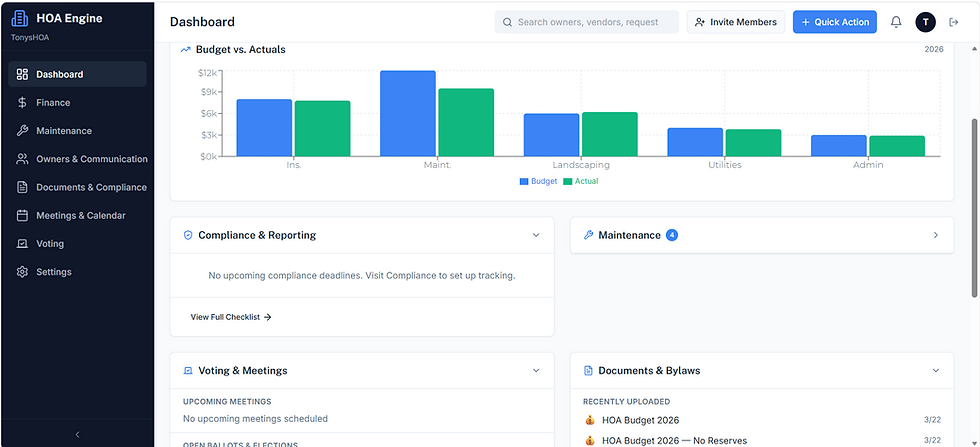
I built HOA Engine because I could not find a platform that had the accounting depth Florida associations need at a price point that made sense for self-managing communities. Here is what the accounting module actually contains.
Full double-entry bookkeeping with a proper chart of accounts, general ledger, and journal entries. This is not a simplified ledger. It is real accounting that produces proper financial statements.
Bank account integration through Plaid gives live transaction feeds directly into the ledger. For associations whose bank does not support Plaid, PDF bank statement upload and parsing handles the import. Smart deduplication prevents transactions from being entered twice regardless of source. Manual sync date adjustment handles the edge cases.
Two-way QuickBooks sync for associations that have an existing accounting relationship and do not want to abandon it. HOA Engine can run alongside QuickBooks rather than replacing it if that is what your community needs.
Check scanning with OCR lets the treasurer photograph a physical check on their phone and have it parsed and entered automatically. For small associations that still receive physical dues payments, this eliminates one of the most tedious manual entry workflows.
Vendor payouts go through Stripe Connect with ACH support, meaning the association can pay vendors directly through the platform with a full audit trail rather than writing checks manually.
The budget builder is AI-assisted. Rather than starting from a blank spreadsheet every fall, the system uses your actual spending history to suggest next year's budget by category and flags variances that need explanation.
All the Florida-specific documents are generated natively: estoppel certificates, Form 1120-H, 1099-NEC, violation letters, dues invoices, reserve study summaries, insurance summaries, and the Annual Disclosure Packet required for Florida condo associations. One click produces the full compliance bundle.
The owner portal is integrated. Owners see their dues, their payment history, their violation status, and association documents through the same platform the board uses for accounting. No second system. No synchronization problem.
At $19.99 per month on an annual plan, the accounting module alone costs less than one hour of a CPA's time. For most Florida self-managing associations, replacing the combination of QuickBooks plus a separate owner access solution plus manual document preparation with HOA Engine produces meaningful cost savings and eliminates the gaps that create compliance risk.
When QuickBooks Still Makes Sense
I want to be direct about the scenarios where QuickBooks is the right call rather than dismissing it entirely.
If your treasurer is a CPA or experienced bookkeeper who is comfortable with the workarounds, already has QuickBooks deeply configured for your association, and has a separate system handling owner communication and document access, migrating away from a working setup creates disruption risk that may not be worth it.
If your association is very small and has genuinely simple finances, the QuickBooks limitations matter less. An eight-unit community with consistent dues, no delinquencies, and minimal vendor activity can run on QuickBooks without many of the gaps becoming critical problems.
If your association already has an integrated management platform for everything except accounting and that platform connects to QuickBooks, the existing integration may be the right foundation to build on rather than replacing it.
Outside those scenarios, for Florida associations that are self-managing, that have more than a handful of units, that are approaching any of the 2026 compliance requirements, or that are tired of maintaining workarounds and managing multiple disconnected systems, purpose-built HOA accounting software produces better outcomes at comparable or lower cost.
The bottom line on QuickBooks for Florida HOA accounting is not that it is bad software. It is that it was not built for you, and the gaps that creates are gaps you have to fill manually. Every hour the treasurer spends maintaining QuickBooks workarounds, generating documents outside the system, managing owner record access in a separate platform, and tracking Florida compliance requirements that the software knows nothing about is an hour that costs the community either money or volunteer burnout.
Purpose-built HOA accounting software exists to close those gaps. For Florida communities in particular, the compliance requirements that arrived with the 2024 and 2025 legislative changes make the gaps more consequential than they were two or three years ago.
If you want to see what purpose-built looks like for a Florida community, visit hoaengineer.com. HOA Engine is live and running on a real Florida condo association on the Space Coast right now.


Comments