The Best HOA Management Software for Florida Self-Managing Communities in 2026

I want to start this post with a confession that will either make you trust me more or trust me less depending on your perspective.
I built HOA management software. HOA Engine is a platform I wrote specifically for Florida HOA and condo communities, and I run it on my own association right now during its beta phase. That is a conflict of interest and you deserve to know it upfront.
Here is why I am telling you this and then writing the comparison anyway. I built HOA Engine because I tested every platform on this list and none of them had what I needed as a Florida board president. Not one of them had Florida-specific compliance tracking for Chapters 718 and 720. Not one generated a Florida-compliant estoppel certificate in one click. Not one tracked board member certification deadlines under Florida Statute 720.3033. Not one had an AI assistant that could actually read my bylaws and answer questions about them.
So I built it. And since it is now live and running on my own community, I can review it the same way I review the others: by what it actually does and does not do.
What follows is the most honest comparison of Florida HOA management software you will find anywhere in 2026, written by someone who has used these tools from the board president's chair, not from a marketing department.
What Florida Boards Actually Need That Generic Software Usually Misses
Before getting into specific platforms, here is the framework I use to evaluate any HOA software for a Florida community.
Florida compliance specificity. Florida has more community association law than virtually any other state and it changes every legislative session. Software that was built generically and then "supports Florida" through a checkbox is not the same as software built with Florida Chapters 718 and 720 as the foundation. The difference shows up in whether the platform tracks board certification deadlines, generates Florida-form estoppel certificates, handles the 115% budget rule for condos, or knows the difference between an HOA and a condo association when it comes to reserve requirements.
Double-entry accounting versus basic ledger. Most HOA software offers a simplified ledger or connects to QuickBooks. That works for routine dues tracking. It breaks down for associations that need proper fund separation between operating and reserve accounts, check scanning with OCR, vendor payouts via ACH, and financial reports that match what Florida statute requires associations to distribute to owners. Double-entry accounting is not more complicated for the board. It is more accurate and more defensible.
Owner portal quality. Florida law now gives owners significant rights to access records and communicate with the board. The platform's owner portal is not a nice-to-have. It is a compliance tool. Owners who can see their payment history, access governing documents, view violation status, and submit maintenance requests through a self-service portal are exercising statutory rights. Boards that handle all of this through email and phone calls are creating more work and more risk.
Price transparency. HOA software is priced in ways that obscure the true cost. Per-unit pricing sounds small until you multiply it across 50 or 100 units. Add-on modules for features you assumed were included. Payment processing fees that apply to every single dues payment. Setup fees and data migration costs. Look at total annual cost, not headline monthly price.
Florida-specific document generation. Estoppel certificates, violation letters, annual disclosure packets, Form 1120-H, 1099-NEC tracking, corporate annual report prompts — a Florida association generates all of these. Software that requires you to build these outside the platform is not truly integrated.
The Platforms
HOA Engine
Built by: Tony Spagnolia, Florida condo board president and software engineer
Price: $19.99 per month annually or $24.99 month-to-month, flat regardless of unit
count
Status: Live beta, currently running on a Florida condo association on the Space Coast
I will be direct about what HOA Engine does because I built it and I know exactly what is in it.
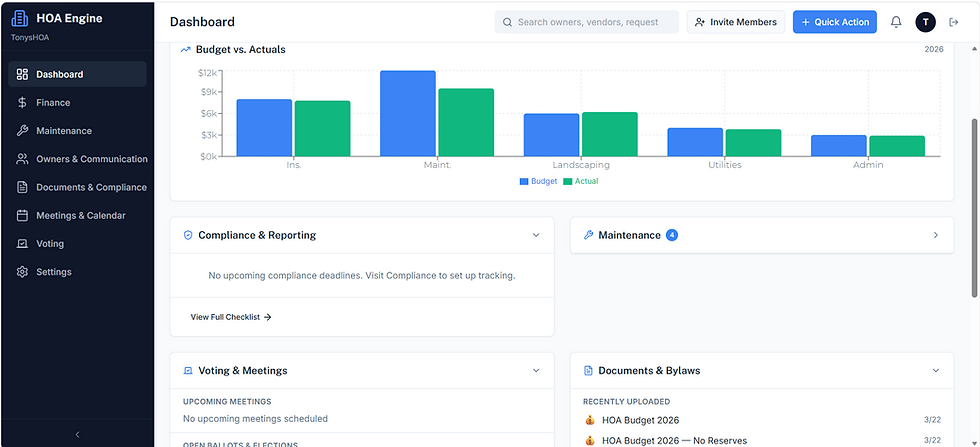
The accounting module is full double-entry bookkeeping with a proper chart of accounts, general ledger, journal entries, bank reconciliation, and monthly statements. It connects to bank accounts via Plaid for live transaction feeds, accepts PDF bank statement uploads when Plaid is not available, and uses smart deduplication to avoid double-counting transactions. It also offers two-way QuickBooks sync for associations that have an existing accounting relationship. Check scanning with OCR lets the treasurer photograph a physical check and have it parsed and entered automatically. Vendor payouts go through Stripe Connect with ACH support.
The compliance module is built specifically for Florida. It tracks Florida Statute 718 and 720 requirements, monitors board certification deadlines under 720.3033 and 718.112, generates Florida-compliant estoppel certificates in one click, produces the One-Click Compliance Bundle that packages the documents Florida associations need for annual distribution, and tracks structural integrity reserve study and milestone inspection deadlines with their specific DBPR reporting requirements.
The governance module includes elections and ballot management, an AI Bylaws Assistant that lets you chat with your governing documents to get plain-language answers to specific questions, meeting scheduling with integrated video conferencing via Jitsi, AI-assisted meeting notes, and attendance tracking.
The owner portal gives residents self-service access to dues payment, payment history, violation status, maintenance request submission, document access, and ballot participation.
The communications module includes a shared inbox with dynamic webmail routing, broadcast emails with recipient picker, transactional emails for every major workflow, and an in-app notification system.
The document module handles storage, access control, e-signatures for consent forms and legal documents, and PDF archival of all signed documents.
It also generates Form 1099-NEC and tracks W-9 collection from vendors, produces IRS Form 1120-H, and includes a data migration wizard for boards moving from another platform.
What it does not have yet: a polished public-facing marketing website for your community (though the owner portal functions as a password-protected member hub), and some workflows are still being refined based on real-world beta feedback from my own community.
What makes HOA Engine different from everything else on this list is the combination of price, Florida specificity, and depth. At $19.99 per month flat, it is the least expensive full-featured platform on the market by a significant margin. And it is the only platform where the person who built it is also the person running it on a real Florida community association right now.
PayHOA
Built by: Venture-backed startup, $27.5M Series A in 2024
Price: Starts at $54 per month for up to 25 units on annual billing, scaling to $109 for 51 to 100 units, $142 for 101 to 150 units. Payment processing fees are additional and apply to every online dues payment.
PayHOA is the most widely used HOA platform for self-managed associations and it has earned that position. The interface is genuinely clean and easy to learn. The dues collection and basic accounting work well. Customer support is responsive. The platform has been actively improving for years and has over 5,000 communities using it.
For Florida specifically, the gaps are real. PayHOA does not have Florida-specific compliance tracking. There is no board certification deadline monitor, no Florida-form estoppel certificate generation, no differentiation between Chapter 718 condo requirements and Chapter 720 HOA requirements. The accounting module does not enforce fund separation between operating and reserve accounts, and reserve tracking does not map to SIRS component categories. Boards that need compliance documentation specific to Florida's post-Surfside requirements will need to handle those outside the platform.
The other consideration is pricing as communities grow. At 25 units or fewer the $54 starting price is reasonable. At 50 units you are at $109. At 100 units you are at $142 plus payment processing fees on top. The per-unit scaling means the annual cost grows significantly as your community size increases, in contrast to HOA Engine's flat rate regardless of size.
PayHOA is a solid choice for a self-managing board that wants a proven, easy-to-use platform and does not have Florida-specific compliance needs that fall outside the mainstream. It is genuinely good software. It is just not built for Florida.
HOALife
Built by: HOALife Inc.
Price: Not publicly listed, requires a demo request
HOALife's strongest feature by a significant margin is violations. The inspection workflow with GPS-enabled photos, automatic notice generation, and cure tracking is the most purpose-built violation management system of any platform reviewed here. For Florida communities in municipalities that actively enforce deed restriction compliance, HOALife gives you a defensible documented process.
HOALife's accounting connects to QuickBooks rather than managing it natively, which means the limitations of QuickBooks for HOA accounting carry through. No enforced fund separation, no reserve study mapping, no native estoppel generation. The non-transparent pricing also creates a barrier for boards that want to understand their costs before investing time in a demo.
HOALife is worth looking at if violation management is your primary need and you already have a satisfactory accounting solution. As a complete Florida community management platform, the accounting and compliance gaps are significant.
HOAworks
Price: Not publicly listed, professional services add-ons available
HOAworks positions itself as software plus optional professional services, allowing associations to add accounting, bookkeeping, and management support on top of the platform. For boards that want the option to offload specific functions, this hybrid model has appeal.
The platform covers the core functions: financial management, violations, document storage, communications, and owner portals. It does not appear to have Florida-specific compliance tracking built in, and the non-transparent pricing with professional services add-ons makes it difficult to calculate actual annual cost without going through a sales conversation.
Buildium
Built by: RealPage (acquired from Buildium)
Price: Essential plan starts at $62 per month, Growth at $192 per month, Premium at $400 per month
Buildium started as rental property management software and expanded into HOA management. The depth of the rental management tools exceeds what most HOA associations need, while the HOA-specific features lag behind purpose-built platforms. It has no Florida-specific compliance tracking, and the pricing at the higher tiers adds up quickly relative to what a small to mid-size self-managed Florida association actually needs.
Buildium makes more sense for a professional property management company that manages a mixed portfolio of rentals and HOAs and wants a single platform for everything. For a self-managed Florida community association, the HOA-specific gaps and pricing make it a difficult fit.
The Honest Recommendation
For a Florida self-managing HOA or condo board that wants a complete, Florida-specific, full-featured platform at a price that does not consume your budget, HOA Engine is what I would recommend. Not because I built it but because the combination of Florida compliance specificity, double-entry accounting, AI-assisted governance tools, and $19.99 per month flat pricing does not exist anywhere else in this market.
For a Florida board that wants a proven, widely-used platform with strong community support and is willing to manage Florida-specific compliance requirements outside the software, PayHOA is the strongest of the established options.
For violation management specifically, HOALife's inspection and notice workflow is the best available if that is your primary need.
The worst outcome for any Florida self-managing board is staying on spreadsheets and email because the software options seemed confusing or expensive. Every platform reviewed here is dramatically better than the alternative, and the combined cost savings from dropping even a partial property management arrangement in favor of good software typically runs thousands of dollars per year.
If you want to see HOA Engine in action and give feedback during the beta phase, visit hoaengineer.com to get started. The platform is live, it is running on a real Florida community today, and early users are shaping how it develops.


Comments