Florida HOA and Condo Website Requirements in 2026: What Your Association Must Post and When

When I first heard that Florida was going to require HOA and condo associations to maintain a compliant website, I will be honest: my first reaction was somewhere between an eye-roll and mild panic. I am the president of a small beachside condo community on the Space Coast. None of us got into this to run a web operation.
But the more I dug into what is actually required and why, the more I realized the law is solving a real problem. Before this requirement existed, owners who wanted to see the budget had to submit a written request and wait. Owners who missed a meeting and wanted the minutes had to track down the secretary. Owners considering buying into a community had no easy way to verify the association was being run responsibly. The website requirement changes all of that, and it turns out most of what it asks for is stuff a well-run board should already be maintaining anyway.
Here is exactly what Florida law now requires, who has to comply, and how to actually do it without spending a lot of money or time.

Who Is Required to Have a Compliant Website Right Now
The thresholds differ between condo associations and HOA communities and the deadlines are different too.
For condominium associations governed by Chapter 718, the requirement took effect January 1, 2026 for any association with 25 or more units. Previously the threshold was 150 units, meaning most small and mid-size condo communities were exempt. That changed overnight when HB 1021 took effect. If your condo association has 25 or more units and does not have a compliant website or secure member portal in place today, you are currently non-compliant.
For homeowners associations governed by Chapter 720, the website requirement took effect January 1, 2025 for any HOA with 100 or more parcels. If your HOA has 100 or more parcels and has not addressed this, you are a year behind.
Associations below these thresholds are not legally required to maintain a website. But even small communities benefit from one. When owners can access the budget, the minutes, and the insurance policy themselves without calling the board, the board gets fewer questions and fewer disputes. I would argue it is worth doing regardless of whether the statute requires it.
What the Website Must Include
Florida law is specific about what must be posted and accessible. The website must have a password-protected section that is not accessible to the general public. Owners get login credentials. The public side of the website can have general information but the documents themselves must be behind a password wall.
Here is what must be posted in that protected section:
The governing documents. This means the declaration, the bylaws, the articles of incorporation, and all rules and regulations, including any amendments that have been adopted. If your governing documents have been updated over the years and you have multiple versions floating around, get the current versions organized and uploaded.
Approved meeting minutes for the past 12 months. Every set of board meeting minutes and member meeting minutes that has been approved in the last year must be accessible on the website. Under the updated requirements from HB 913, this now includes video recordings of virtual board meetings from the past 12 months, which must be posted within 30 days of the meeting.
The current annual budget and any proposed budget under consideration. If the board is in budget season and has a draft budget circulating, that goes up too.
Annual financial reports and audits. The most recent annual financial statement, whether that is a compilation, review, or full audit depending on your association's size and revenue, must be posted.
Current insurance policy summaries. Owners have a right to know what insurance the association carries. A summary of each active policy including the carrier, coverage type, policy period, and key coverage amounts satisfies this requirement.
All contracts currently in effect with vendors. Every active vendor contract, landscaping, management, pool service, security, whatever you have in place, must be posted. This one surprises a lot of boards.
Contact information for whoever handles estoppel certificate requests. When a unit is being sold, the buyer's closing attorney or title company requests an estoppel certificate from the association confirming what is owed and what assessments are current. The website must include contact information for the person or entity that handles these requests.
All structural inspection reports. This means any milestone inspection reports and any completed Structural Integrity Reserve Studies. These must go on the website when received and stay there.
Meeting notices and agendas. Notice of board meetings must be posted to the website no later than the minimum statutory notice period before the meeting. For regular condo board meetings that is 48 hours. The notice must include the agenda, and any documents that are required to accompany the notice such as a proposed budget for the budget meeting must also be posted at that time.
The 30-Day Posting Rule
This is the operational requirement that catches most boards off guard. It is not enough to do a one-time upload and consider yourself compliant. Florida law requires that new documents and records be posted to the website within 30 days of creation or receipt.
What that means in practice: you approve the minutes from your March board meeting in April. Those minutes must be posted within 30 days of approval. You sign a new landscaping contract in June. It must be posted within 30 days of execution. You receive your milestone inspection report in August. It must be posted within 30 days of receipt.
This is an ongoing operational obligation, not a one-time setup. Build the 30-day posting requirement into your board's workflow. The secretary or whoever maintains the records should have a standing task to post new documents as they are finalized rather than batching everything together quarterly.
What Must Never Be Posted
The law also specifies what must be redacted or kept entirely off the website. This matters as much as knowing what must be posted.
Individual owner financial information, including account balances, payment history, and delinquency details, must not be posted publicly or made accessible to other owners. Financial reports that show association-wide totals are fine. Reports that identify individual owner balances are not.
Social security numbers, driver's license numbers, and other personally identifiable information must be redacted before any document containing them is uploaded. If an owner's emergency contact form contains their social security number, that information comes out before the document goes up.
Personnel records for any association employees must not be posted. Medical records are similarly protected. Attorney-client communications and documents prepared in anticipation of litigation must not be posted.
If a document that is otherwise required to be posted contains protected information, the solution is to redact the protected portions before uploading rather than withholding the entire document. The board's attorney can advise on redaction practices if there is any question about what must be removed.
The Penalties for Non-Compliance
This is where the law has real teeth that boards need to understand.
A board member or manager who willfully and knowingly refuses to provide an owner with access to official records, whether through the website or through a direct request, is committing a second-degree misdemeanor under Florida law. A conviction can result in removal from office.
Separate from criminal penalties, owners who are wrongfully denied access to official records can recover $50 per day for each day access was delayed beyond the statutory deadline, starting on the 11th business day after the request was made. If a board ignores a records request for 30 days, that is a potential $950 in penalties owed to the requesting owner.
Florida's Division of Condominiums can also take administrative action against associations that are non-compliant with the website requirement, and non-compliance can complicate an association's ability to demonstrate good governance during insurance underwriting, lender reviews for buyer financing, and any DBPR complaint investigations.
I am not raising these penalties to alarm you. I am raising them because they are real and because getting the website right is genuinely straightforward compared to the exposure of ignoring it.
How to Actually Build a Compliant Website Without Spending a Fortune
You do not need to hire a web developer. You do not need to spend thousands of dollars. Here is the practical reality.
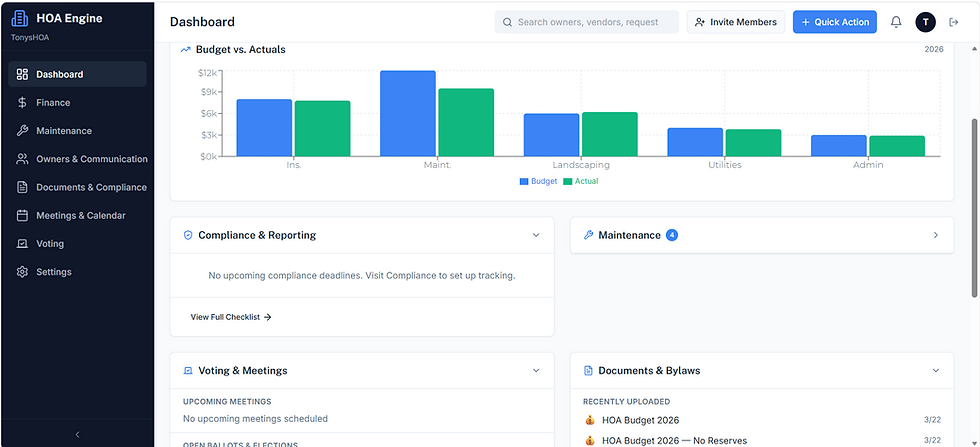
There are platforms built specifically for Florida community associations that handle the compliance requirements out of the box. They know what categories of documents need to be posted, they organize everything by type, they provide secure password-protected access for owners, and they handle the technical security requirements the statute specifies. Many of these platforms run in the range of $30 to $100 per month for small communities. For a ten-unit community that is $3 to $10 per owner per month, which is a trivially small line item in an HOA budget compared to landscaping, insurance, or any other recurring expense. HOA Engine is a compliant platform built by myself.
If your community is very small and very budget-conscious, even a simple solution works. A shared cloud storage folder with access-controlled links, organized into clearly labeled sections for governing documents, financials, minutes, insurance, contracts, and inspection reports, satisfies the functional requirement even if it is not as elegant as a purpose-built platform. The statute requires that the records be accessible and password protected. It does not specify how sophisticated the platform must be.
What matters is that it is organized, that it is current, that owners can access it without calling the board, and that the 30-day posting workflow is actually being followed.
Records Retention: The Back-End Requirement
The website is the front-end requirement. The back-end requirement is records retention. Florida law requires that most official association records be maintained for seven years. This includes all financial records, meeting minutes, vendor contracts, official correspondence, inspection reports, and anything else that constitutes an official record of the association.
Some records must be kept longer. The SIRS report must be retained for at least 15 years. Governing documents, recorded liens, and legal correspondence should generally be kept indefinitely.
Build your filing system, whether digital or physical, with those retention periods in mind from the start. A cloud-based document management system that automatically retains records with date stamps is far easier to maintain than physical files that need to be manually culled every few years. Most of the platforms designed for Florida community associations handle retention automatically.
The broader point is that the website requirement is not just a compliance obligation. It is an opportunity. Every dispute I have seen between Florida HOA boards and owners traces back in some way to a lack of transparency, an owner who felt they did not know what was going on, or a board that was making decisions without explaining them. A well-maintained website removes most of those friction points before they become problems.
Owners who can see the budget, the minutes, the insurance policies, and the vendor contracts themselves do not need to call the board to find out if the association is being managed responsibly. They can see it. That kind of transparency is what builds the trust that makes every other difficult board decision easier.
For a complete guide to running a Florida HOA or condo association including compliance, finances, vendor management, and the decisions every board faces, pick up a copy of Run the Board. For a compliant website app designed by a board president, check out HOA Engine.


Comments